AUTONOMOUS DRIVE
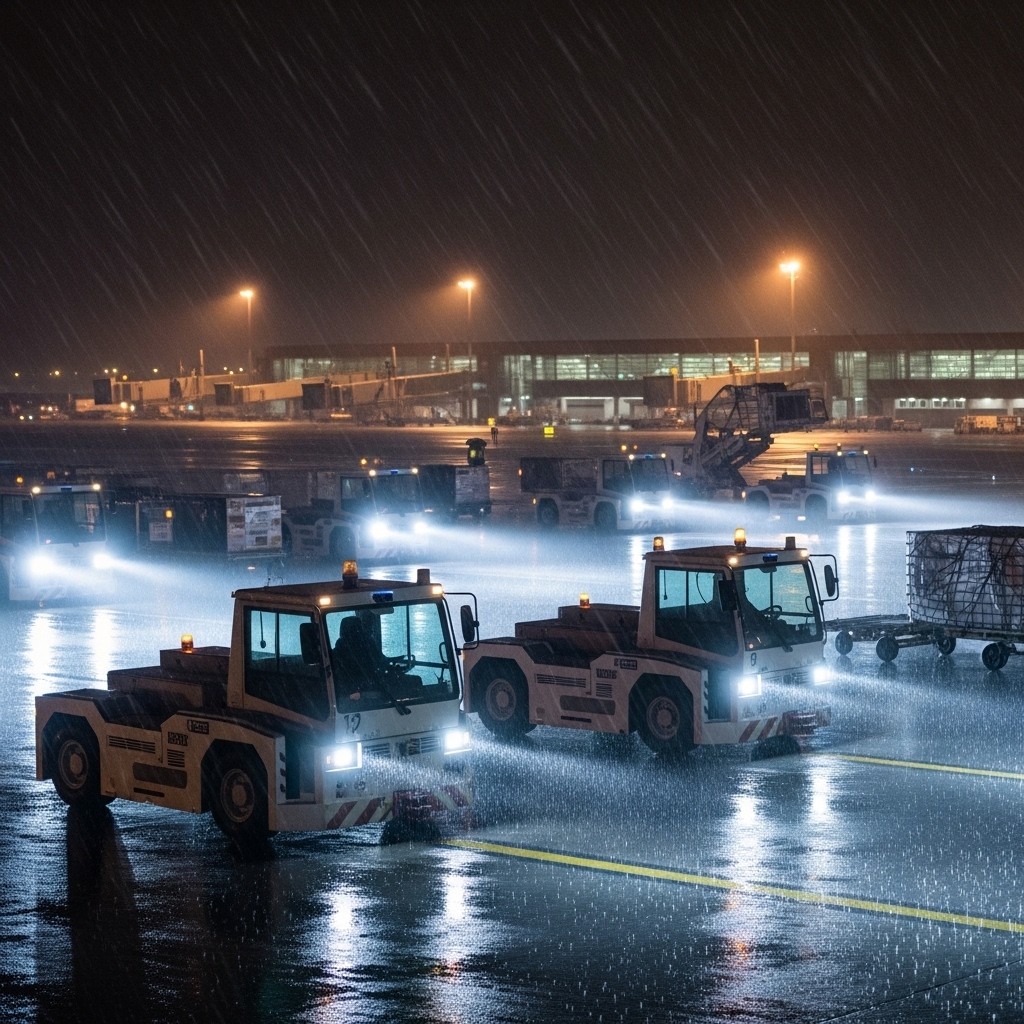
In autonomous yard operations, the "eyes" of the system—the computer vision model—are only as good as the diversity of their training. The underestimated challenge for object detection isn't so obvious; it’s the obscure, static, and irregular obstacles that blend into the background or defy standard classification.
The Failure of Feature Extraction in the Yard
Most vision models are trained on datasets dominated by "clean" examples. However, a logistics yard is a graveyard of visual noise. When a perception engine fails to detect a static object, it’s usually due to one of three "vision" failures:
Low-Contrast Shadows: A dark, weathered concrete barrier at dusk can easily be "suppressed" by a model that hasn't seen enough low-light edge cases.
Geometric Ambiguity: Specialist ground equipment, like an old aircraft tug or a bespoke cargo spreader, doesn't look like a "vehicle" to a model trained on COCO or Waymo datasets.
Visual Occlusion and Camouflage: A rusted barrier against a rusted container background creates a "texture crawl" that standard feature extractors often fail to segment.
If the "eyes" of the vehicle fail to generate a high-confidence detection, the autonomous software downstream is effectively paralyzed—or worse, dangerously unaware.
Improving Object Detection with Synthetic Data
Repli5 provides the high-fidelity synthetic imagery required to bridge this perception gap. We don't just provide "images"; we build targeted datasets for the objects that real-world logging misses.
1. Training for Visual Variety, Not Just Volume
To a computer vision model, a "barrier" isn't a single concept. It is a collection of textures, edges, and light-reflectance values. We programmatically generate thousands of variations of static obstacles:
Weathered Textures: Adding rust, salt-corrosion, and grime to barriers to ensure the model recognizes the shape, not the color.
Irregular Geometry: Modeling obscure objects like blast fences, tripod jacks, and non-standard bollards that exist only in specific industrial hubs.
2. Perfect Labels for Complex Segmentation
Manual annotation of "strange" objects is notoriously prone to human error. A tired annotator might miss the thin edge of a tripod jack or poorly define the boundary of a collapsed pallet.
Repli5’s synthetic data comes with pixel-perfect ground truth. Whether it’s 2D bounding boxes or full instance segmentation, the model is trained on 100% accurate data, eliminating the "noise" that hinders mAP (mean Average Precision) scores.
3. Solving for Lighting and Occlusion
We simulate the most difficult optical conditions—glare from wet tarmac, heavy fog, and the long shadows of a clear winter afternoon. By feeding the model these synthetic edge cases, we harden the feature extractor to identify static obstacles even when 70% of the object is obscured or poorly lit.
Perception Challenges: Real vs. Synthetic
Perception Challenge | Real-World Datasets | Repli5 Datasets |
Obscure Class Accuracy | Low (Insufficient samples) | High (Unlimited variants) |
Edge Case Lighting | Hard to capture / Rare | Controlled and repeatable |
Labeling Precision | Human-variable | Mathematically perfect |
The Repli5 Philosophy: Perception First
You cannot solve autonomy with better control algorithms if your vision model is failing to "see" the world accurately. By integrating Repli5’s synthetic data into your training pipeline, you ensure that your perception stack is resilient enough to handle the chaotic, non-standard reality of industrial yards.
We empower your "eyes" to see the barriers, the debris, and the specialist vehicles that other models ignore.
Book a Demo today to learn more about how we can accelerate your perception model training.